

The Post-Streaming Era
Artists are Building Customer Lists that Match Their Catalogs

Artists have long struggled to receive fair compensation for their work, whether the year is 1512 or 2026.
In a sense, things haven’t changed much over the past 500 years.
In the 1500s, artists had patrons who commissioned works and often provided room and board while the works were completed.
Today's patrons are record labels, and, if anything, their status as patrons has shifted slightly toward that of full-fledged business partners and, at times, an obstacle.
Why?
Because the music industry has undergone significant changes over the past 25 years.
At the turn of the century, if you had told the average consumer that CDs would become a thing of the past or that music would be available on demand via a near-endless online library, they might’ve believed you.
Now…
If you had told them about AI, they probably would have told you to f*ck off.
Yet, here we are.
More change. Smaller Budgets. Less money to go around.
That said, artists are finding more ways to take control of their artistic future and the business of their music. To do so, they’re going direct to consumer — speaking to the true patrons of the art that they toil to make.
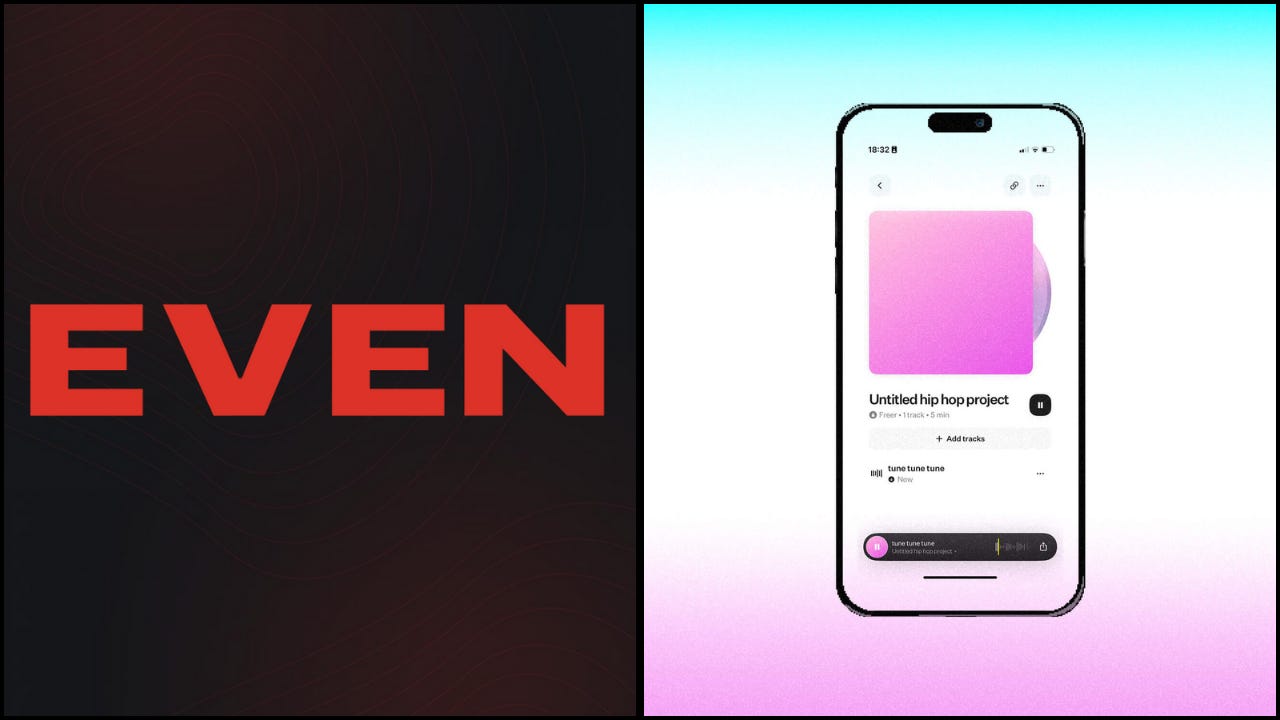
There are two platforms in the music space that are leading the way for this artistic (and distribution) revolution: Even & [untitled].
Together, they show us what the music landscape of the future can look like.
BUT HOW DID WE GET HERE?
Let’s close the loop on that compensation point with a brief story:
When the streaming era began, Spotify became the standard for music consumption.
However, with its rise came numerous questions regarding compensation and ownership.
It was ultimately determined that a song stream is worth less than a penny (approximately $0.007-$0.01). Accordingly, it was also decided that 1,500 streams equaled roughly 1 album sale.
For artists who were already barely earning anything from CD sales—sales that still yielded only a few cents per unit sold —this was egregious.
For context, If we do some rought math…
1 million CDs sold might net the artist a few hundred thousand dollars in royalties (if they’ve recouped costs, of course).
In the streaming era, 1 billion streams could net you as little as $4k, depending on how much of the song they own.
Imagine trying to pay back an advance on that? Or even make a living?
It’s insane.
But this generation of artists consists of digital natives who are fiercely concerned with ownership and independence.
Which brings us to the tech solutions that are filling the gap.
I. EVEN
EVEN is a D2C music platform that allows artists to sell their music directly to fans before it’s released on streaming. Artists can offer everything from exclusive content to bonus tracks, EPs, albums, etc.
It’s an artist-first platform (as evidenced by their “Buy The Art From The Artist” tagline) that features “Pay What You Want” pricing, which allows super fans to demonstrate their support and casual fans to pay a nominal fee for advance access to music.
For some artists, that means receiving as much as $10k for a single copy of their album or other content, while others can access their art for as little as $1.
In essence, EVEN is a stream-era equalizer.
Artists on EVEN can profit from their art in a way that would require millions of streams to achieve on Spotify or Apple Music.
Major labels are also beginning to partner with EVEN for pre-streaming releases of their artists, and big names like LaRussell & J. Cole present strong case studies for the company.
If that wasn’t enough, EVEN also reports sales to Luminate/Billboard, which helps artists with their chart performance.
CASE STUDIES
I. LARUSSELL
Perhaps the biggest case study for EVEN has been LaRussell. He was among the first (if not THE first) artists on the platform and also holds an equity stake in it.
For those who don’t know, LaRussell is a Bay Area native who strongly believes in remaining independent, and he openly shares his journey (including the finances around it) with fans.
LaRussells also releases a large volume of music through EVEN, of which he shares ownership with fans, and has hosted an ongoing concert series from his backyard (and the backyards of fans worldwide).
His newest goal on Even is to sell 100k copies independently (so far, he’s at 20k), and, as noted above, some of his super fans have paid thousands to support him.
He’s even used EVEN for other forms of gated content, including a recent documentary he produced.
II. J. COLE
J. Cole is another major artist who has begun using EVEN to reach consumers prior to album release.
In particular, he’s used EVEN to power the audio series that accompanied the 10th anniversary of his 2015 album, 2014 Forest Hills Drive. Moreover, he created a storefront on the platform to sell the limited-edition vinyl included with it.
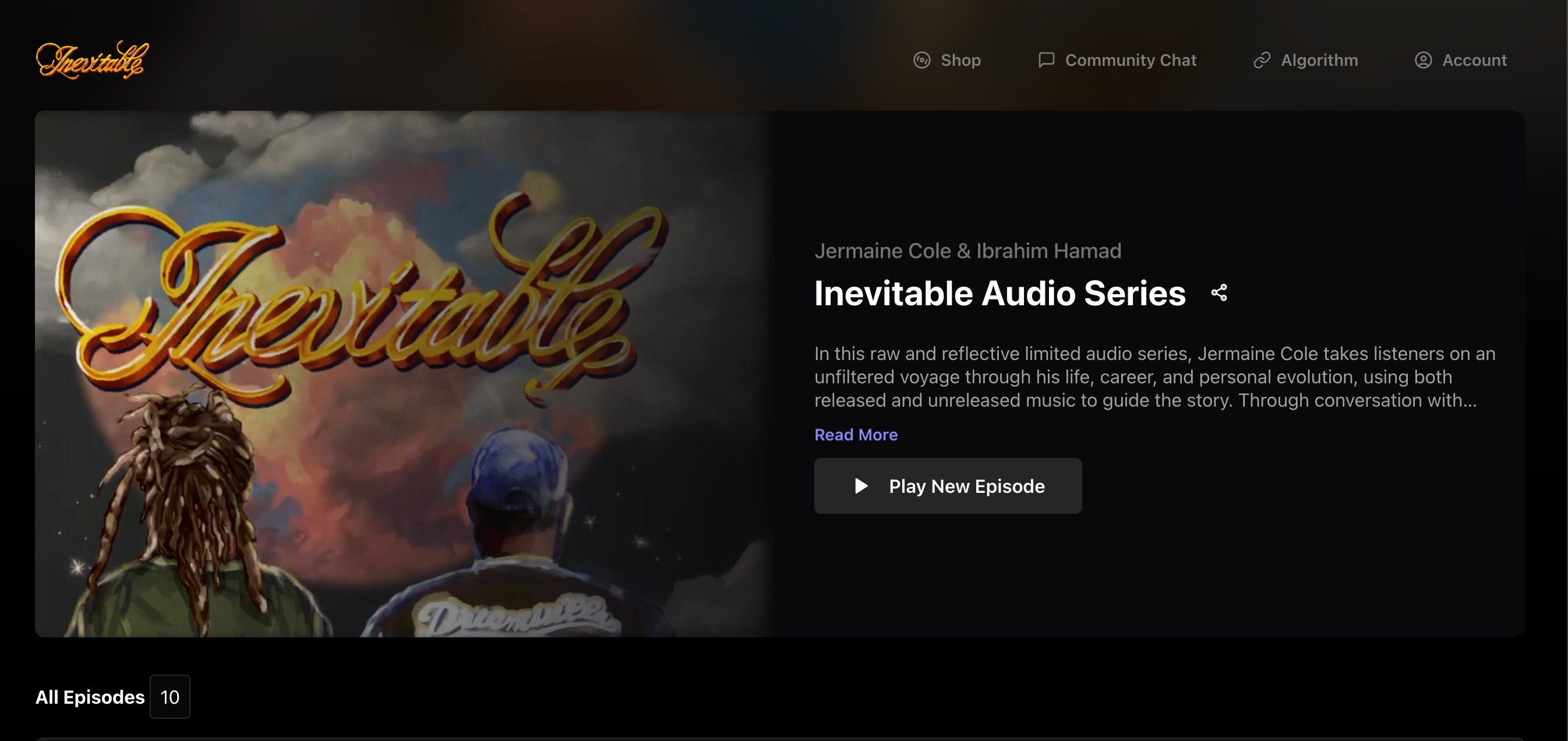
For his current album rollout, Cole is using EVEN’s platform in a multitude of ways.
Earlier this week, he dropped “Birthday Blizzard ‘26,’ a DJ-Clue hosted mixtape which featured “Pay What You Want” pricing (i.e., fans could get it for $1 — a clever reference to his “Dollar & a Dream brand theme)
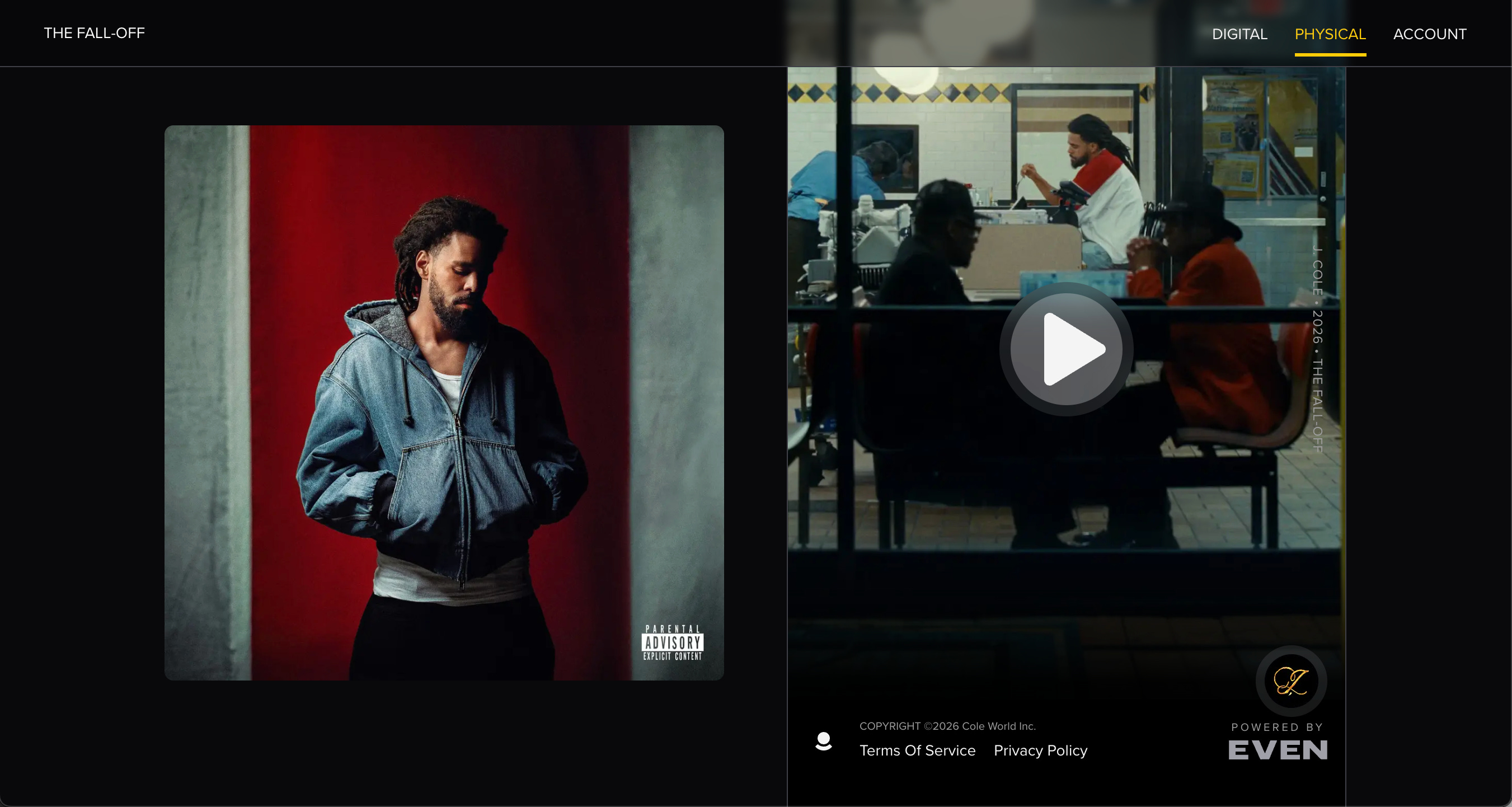
EVEN has also served as the pre-order hub for his February album “The Fall Off.” During the initial announcement, fans were directed to www.thefalloff.com, where they could pre-order the limited-edition vinyl, a digital version of the album, and an alternate-cover CD version.
II. [untitled]
A huge part of the artistic process is working from rough drafts: unfinished songs with partially written lyrics and musical ideas that could potentially become something bigger.
Some artists love to gutcheck their drafts and share ideas intimately before they’re finished. Others like to share demos that never became more.
Regardless of their goal, the preferred option for creatives in both scenarios has been [untitled], which the company describes as a sacred place for your work-in-progress music.
[untitled] acts as a playground for artists where they can not only share their work, but they can also use its editing capabilities to create variations on the fly, i.e., create stems of their work, pitch it up, slow it down, etc. It also offers options for artwork and securing Vinyl versions of an artist’s work.
Last year, underground/independent musicians heavily adopted the platform because of its features, and over time, the [untitled] has evolved into a hub for building a consumer base.
As of this month, [untitled] has introduced a new D2C layer, Paid Projects, which allows creators to place any project behind a paywall and sell access directly within the app.
CASE STUDIES
I. Pink Pantheress & Joey Bada$$
In 2025, [untitled] released two commercials featuring high-profile artists, including Pink Pantheress, that demonstrated how the platform worked, along with exclusive content for fans to view on the platform.
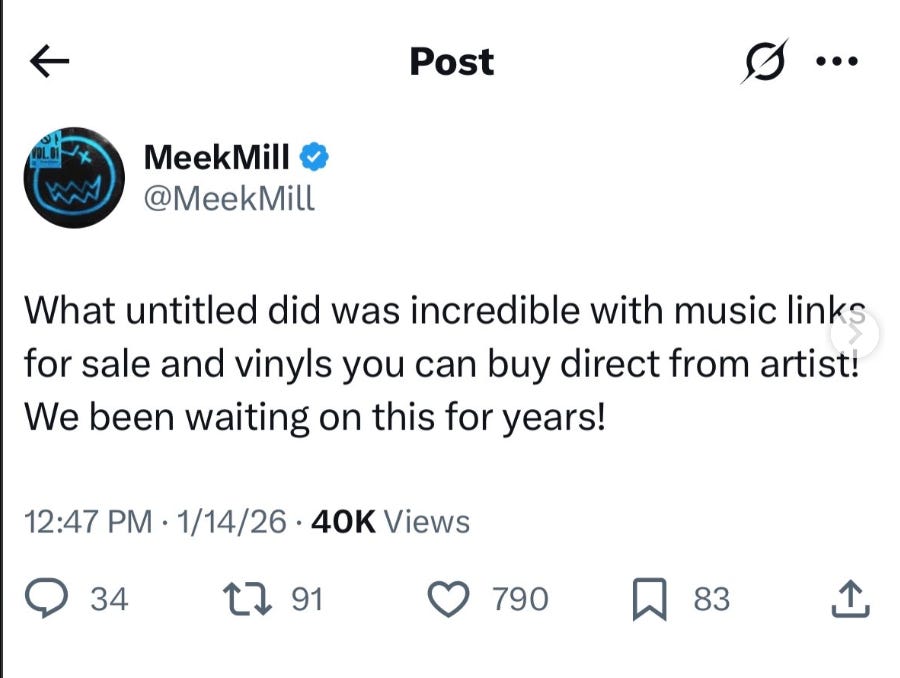
According to social growth engineers, the ads led to over 200k app installs, and in the months since, it has received public cosigns from major artists like Meek Mill, who’s now considering the independent route after spending the bulk of his career on major labels.
Moreover, in a Breakfast Club interview from 2025, Joey Bada$$ stated that he used [untitled] to preview his music with family/friends.
Through the platform, you can set limits on how many times people can listen to your unreleased work, passwords to gate the content, and get notified when someone opens the song.
As a result, an artist like Joey Bada$$ was able to gauge which songs they were feeling and how the album would perform upon release.
WHAT THE FUTURE HOLDS
These platforms represent the first visible cracks in the armor of the streaming era, and they show that the artist/fan experience is heading in a different direction.
While record labels still have the infrastructure to make artists superstars, put them on the radio, etc., artists will continue to find paths of connection with their audience that will help them generate revenue pre- or post-album, and I’m willing to bet these two apps will play a role.
If we read the tea leaves properly, we can see that the future is much like the past in that it’s all about connection to the audience and who owns that connection.
These days, having a patron can be perilous, and creatives are doing what they can to not need one.
Can’t be mad at that.
One.
“We can see that the future is much like the past in that it’s all about connection to the audience and who owns that connection.” I was thinking this as I neared the finish of this. Great info! I learned something and have always felt for artists based on how their sales work (or don’t). Thanks for the enlightenment.💡